Plantation shutters do cool a west-facing room, but only when the louvers are closed, which is also when the view is gone. If the whole point of the room is the water, a solar screen shade at a low openness factor usually gets you more heat control per square foot of glass you can still see through, and shutters earn their keep on the walls where a view is not the priority.
The Westside problem is glass area, not window treatments
Most of the hot-afternoon calls we take in Malibu, Pacific Palisades, and Manhattan Beach are not really about a window. They are about a wall. A house on Point Dume or above The Strand often has 200 to 400 square feet of west-facing glass in one room, no overhang worth mentioning, and a low sun that comes in nearly horizontal from four o'clock on. That geometry is different from an inland house with punched openings and eaves, and it is why interior products behave differently here.
Three things are happening at once, and they need different answers:
- Direct solar gain. Sun passing through the glass and landing on your floor, sofa, and skin. This is the big one, and it is the one an interior treatment can genuinely reduce.
- Conduction. Heat moving through the glass itself. Older single-pane sliders in Santa Monica Canyon and Malibu Colony rebuild-era houses conduct a lot. A treatment can slow this, but not much unless it seals at the edges.
- Glare. Low-angle light bouncing off the ocean, which is not heat but reads as heat and is the reason people close things at 5pm.
Nothing installed inside the glass stops solar gain at the source, because the energy is already through the window by the time it reaches your shutter or shade. Exterior shading, overhangs, and glazing upgrades do that job better. Anyone who tells you otherwise is selling. What an interior treatment does is intercept that energy before it hits your finishes and your body, and how well it does that depends on the material and the mount.
🏠 Want Expert Advice on YOUR Windows?
Send us your window sizes and photos for a quote, usually the same day. Want us to come out with samples and measure? The consultation is free. Call or text us three days and times that work.
What shutters actually do with heat, and what the louver angle changes
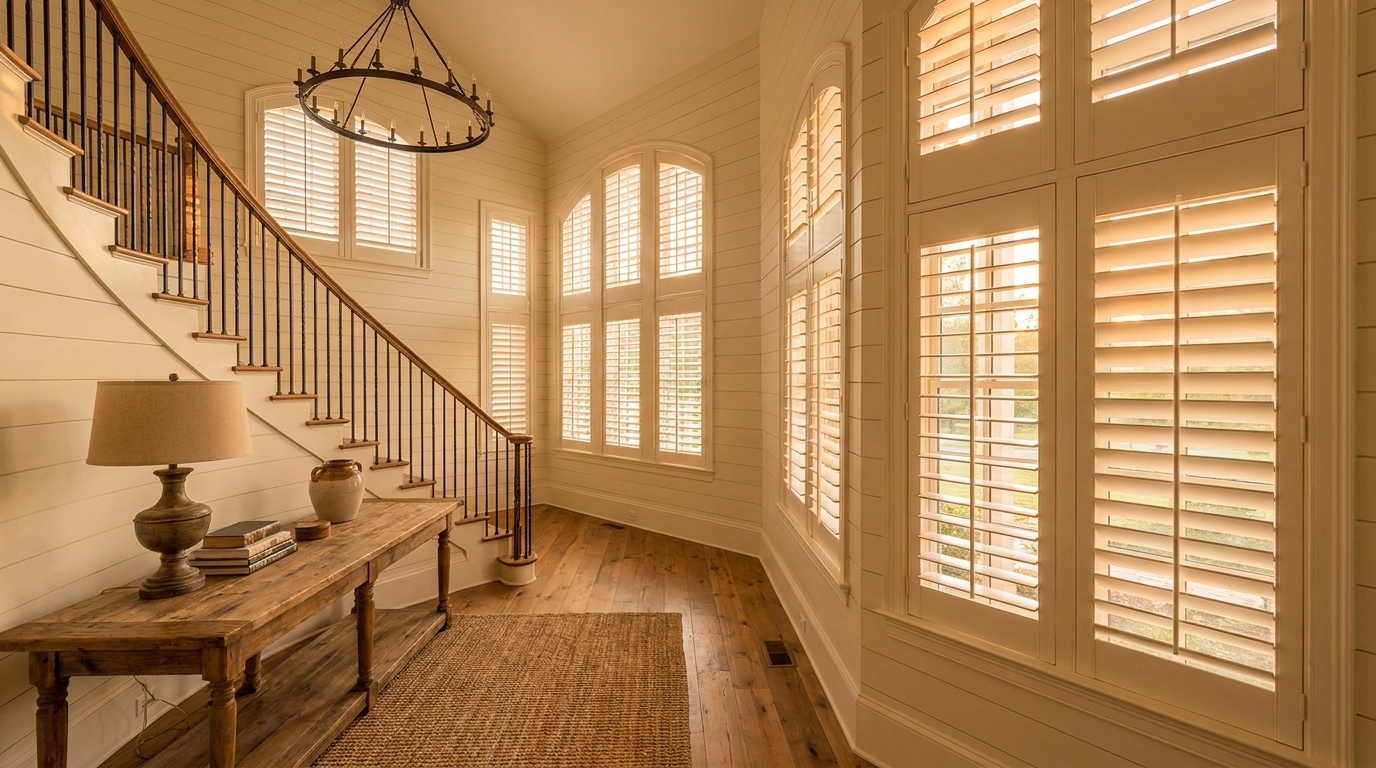
A closed hardwood shutter panel is a solid, fairly thick barrier. It blocks direct sun, it kills glare, and on an inside mount it leaves a pocket of still air between the panel and the glass, which is real insulation value. In a Brentwood Park bedroom or a Beverly Hills street-facing office, closed shutters make a noticeable difference in how the room feels by evening.
The catch is what happens at partial angles, which is how most people actually live with shutters.
- Louvers tilted down aim sunlight at your floor. It is the most common setting because it preserves a sliver of downward view, and it is the worst one for UV on hardwood and rugs.
- Louvers tilted up bounce light onto the ceiling and diffuse it. Cooler-feeling than down, better for fade protection, and you lose the view entirely.
- Louvers open flat give you the view and roughly the heat of bare glass, minus the frame area.
Louver size matters for view, not for heat. On tall glass, 3 1/2 or 4 1/2 inch louvers mean fewer horizontal lines across the water. A 2 1/2 inch louver on a 10-foot panel reads like a fence.
Mount type matters more than most people expect. An outside-mount shutter covers the frame and the perimeter, so there is less light and heat leaking around the edges. An inside mount looks cleaner and keeps the air gap, but you will get light seams at the louver joints and along the stiles. Neither is wrong; they trade sealing for looks.
Plantation shutters run $55 to $95 per square foot installed in our pricing, with a 12 square foot minimum billable per opening. Install is included in that number, not billed after. On a big ocean-facing wall, that square footage adds up fast, which is another reason to be deliberate about where shutters go.
Where a solar or cellular shade beats a shutter
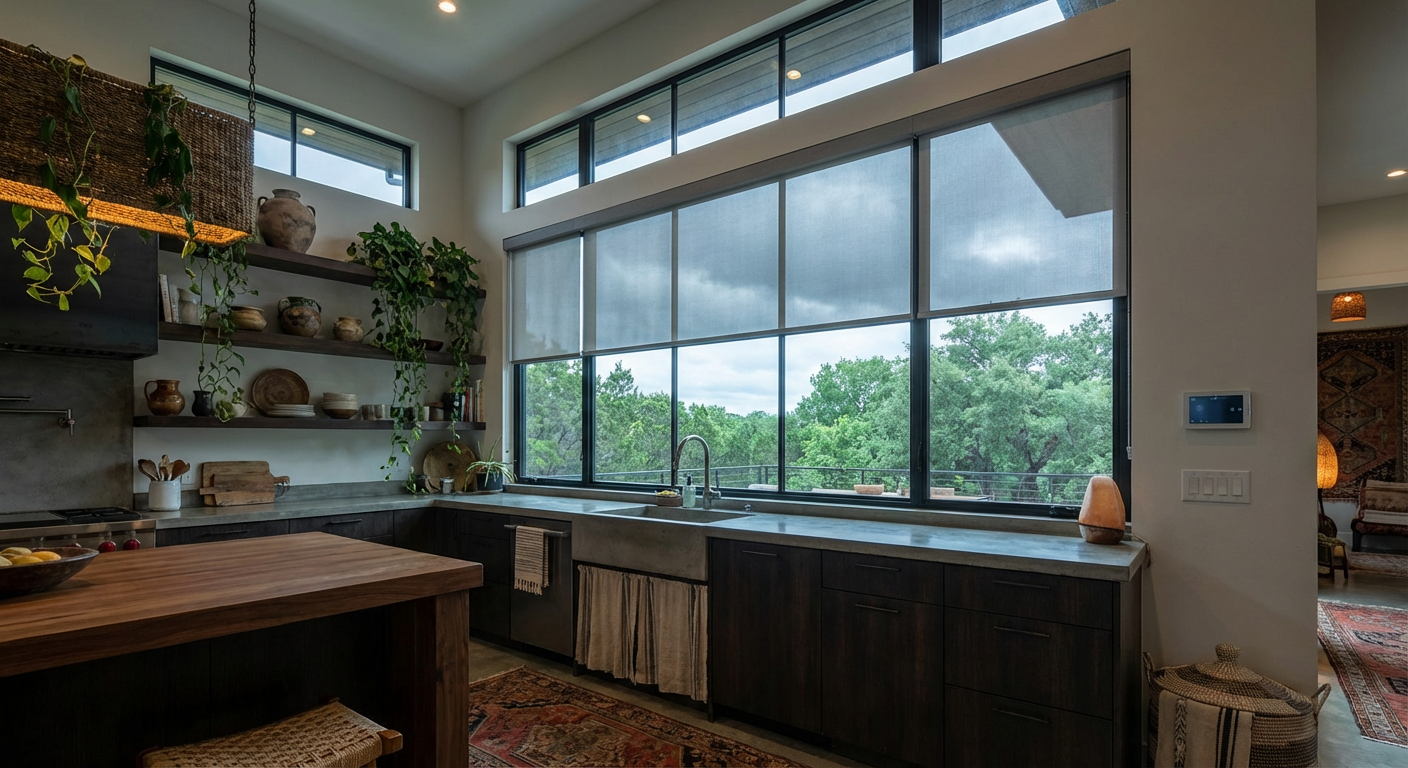
A solar screen shade is a woven fabric rated by openness factor — the percentage of the weave that is open. A 1 or 3 percent screen blocks most of the direct sun and most of the glare while still letting you see the horizon. That is the trick a shutter cannot do: heat control with the view intact. Down at 3 percent you can read the surf line from a Marina del Rey living room at 5pm without squinting.
The color decision is the one nobody explains at the appointment:
- Dark fabrics (charcoal, bronze, black) preserve the view out best because there is less light scattering in the weave. They also absorb more solar energy and re-radiate some of it into the room as warmth near the glass.
- Light fabrics (white, linen, silver-backed) reflect more energy back out through the window, so the room stays cooler, but they haze the view and can glare when the sun hits them directly.
A common answer on a Palos Verdes Estates or Topanga ridge window is a light or metalized backing facing the glass and a darker face toward the room. Ask for it by that description; not every fabric line offers it.
For pure temperature with no view requirement — bedrooms, media rooms, west bathrooms, upstairs hallways in Trousdale Estates — a cellular shade is the strongest interior option. The honeycomb traps air in sealed pockets, and with side channels or a snug inside mount it seals the opening better than a louvered panel can. Roller, solar, zebra, and cellular shades run $495 to $955 per window installed for a typical window; Roman and woven wood run $550 to $1,400. Woven woods look beautiful on a beach house and do very little for heat, so buy them for the texture, not the thermostat.
On tall or hard-to-reach glass, motorization adds $200 to $500 per window. On a west wall it is not a luxury item so much as a scheduling tool: shades that drop at 3:30pm on their own actually get used, and the ones you have to reach behind a sofa to pull do not.
Salt air, UV, and the parts that fail first within a mile of the water
In Venice, Redondo Beach, and anywhere on a Malibu bluff with sliders that stay open, the treatment usually outlives its hardware. What corrodes first:
- Shutter hinges and tilt-rod pins, especially plated steel. Ask what the hinge material and finish are before you sign.
- Magnetic catches on shutter panels, which rust into a stain on a white frame.
- Roller shade brackets, idlers, and continuous-loop chains.
- Motor housings and charge ports on shades near an open slider.
UV is the other coastal tax. Strong reflected light off the water fades floors, art, and fabric faster than most people plan for, and it does it whether or not the room feels hot. If fade protection is the goal, a low-openness solar screen left down through the afternoon does more than shutters that get tilted down and forgotten.
Anything you are quoted here should name the fabric line, the openness factor, the louver size, the mount type, and the hardware finish. If it does not, use our line-by-line quote checklist or upload what you have to the free Quote Check tool. Two shades that look identical on paper can be very different products, which we broke down in why roller shades cost what they cost.
The combination most Westside houses end up with
Room by room, this is what tends to actually get installed once people stop looking for a single answer:
- Ocean-facing living wall: solar screen at 1 to 3 percent, motorized, often on a schedule. View preserved, glare and gain cut.
- West bedrooms: cellular or a room-darkening roller, sometimes behind a drapery panel for the seal at the edges.
- Street and side windows, kitchens, baths: shutters, for privacy, durability, and the fact that they never need replacing like a fabric does.
- Hillside and HOA-sightline lots: whatever satisfies the exterior-appearance rule, which sometimes decides the product before you do.
The measurement that settles it is the one you take yourself: put a thermometer in the room at 4pm, on the same day, with the treatment you have now open and then closed. The delta tells you whether you have a heat problem, a glare problem, or both, and that determines which product you should be spending on.
When you are ready for real numbers, book a visit with 310 Shutters & Shades. Someone comes to the house, measures every window, brings real samples so you can hold a 3 percent screen up to your actual glass at the actual hour the sun is a problem, and you get a firm quote with installation included. The in-home consultation is free.
Frequently asked questions
Do plantation shutters keep a house cooler than shades?
Closed shutters block direct sun and add an insulating air gap, so they cool a room well. But on pure heat gain a low-openness solar screen or a cellular shade with a snug fit can match or beat them, and the screen lets you keep the view. Shutters win on durability, privacy, and rooms where the view is not the point.
What openness factor should I choose for a west-facing ocean view?
A 1 to 3 percent solar screen blocks most direct sun and glare while still letting you see the horizon. 5 and 10 percent screens show more view but let through noticeably more light and heat on a low afternoon sun.
Should the shade fabric be dark or light for heat?
Dark fabrics preserve the view out best but absorb more solar energy. Light or metalized fabrics reflect more energy back through the glass and keep the room cooler, but they haze the view. A fabric with a reflective backing facing the glass and a darker face toward the room is often the compromise.
Which hardware holds up in salt air near the beach?
Ask about hinge material and finish on shutters, magnetic catch quality, and bracket, idler, and chain material on roller shades. Plated steel parts within a mile of the water tend to corrode first, and motor housings near an open slider are worth specifying carefully.
What do plantation shutters cost installed on the Westside?
Our range is $55 to $95 per square foot installed, with a 12 square foot minimum billable per opening. Installation is included in the quoted price, and the install warranty is 12 months. Manufacturer warranties vary by product.
Ready to See Your Options?
- Remote quote from your sizes and photos
- See real samples in your space
- We carry every major manufacturer