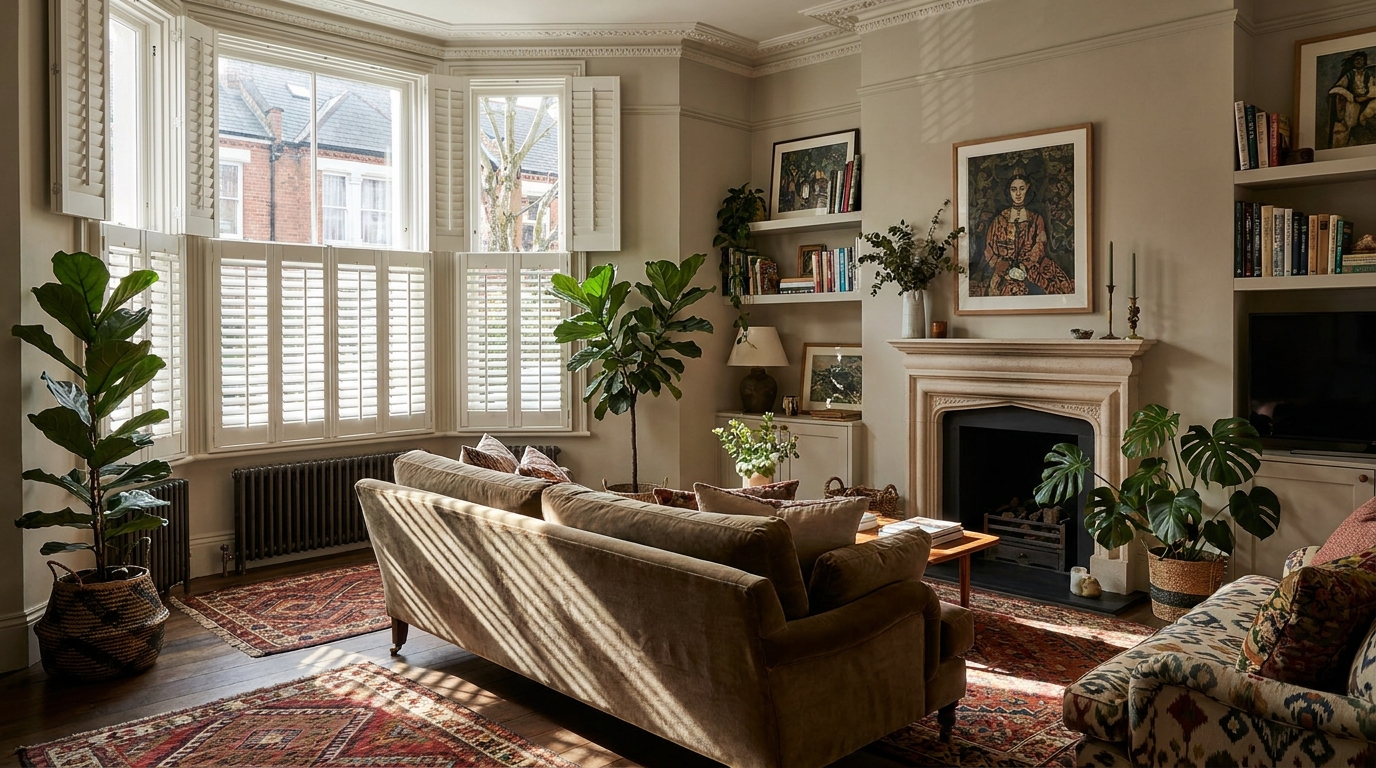
Within a mile of the water, plantation shutters hold up better than almost any blind, because the failure point on a coastal blind is the hardware — the tilt mechanism, the lift cord, the metal headrail — and a shutter has far less of it. Blinds still win on cost and on rooms where you need a cheap, functional cover fast, which is why most Westside houses we measure end up with both.
What salt air and low sun actually do to a window covering in Malibu and the South Bay
The coastal strip from Point Dume down through Marina del Rey and The Strand in Manhattan Beach is a different operating environment than a house five miles inland, and it shows up in window treatments within about two years.
Three things are at work:
- Salt aerosol. It settles on everything, and it does not need an open window to get in. It gets into a blind's tilt gearbox, its cord locks, and the steel components inside a headrail. Cheap plated hardware pits, then binds, then snaps. This is the single most common reason a beach-house blind stops working while the slats still look fine.
- The marine layer. Morning humidity plus afternoon dry heat is a swelling-and-shrinking cycle. Real hardwood moves with it. Basswood shutters in a Santa Monica Canyon bathroom or a Venice walk street unit can stick at the louver pins if the wrong material was specified.
- UV, amplified by water. Light bouncing off the ocean hits west and southwest glass at a very low angle from about 4pm on. It fades white oak floors, leather, and art, and it degrades vinyl and low-grade fabric. A shutter that is closed stops it entirely. A shutter that is tilted does not.
So the coastal question is not really "which looks better." It's which product's weak point you can live with.
In Malibu & West Los Angeles? Get a free quote from a local installer
Send us your window sizes and a few photos and we'll quote you, usually the same day. Want us to come out with samples and measure? The consultation is free. Call or text us three days and times that work.
Serving Malibu, Pacific Palisades, Santa Monica, Brentwood, Bel Air and nearby.
Light, glare, and view: a 4 1/2-inch louver versus a 2-inch slat
A plantation shutter louver is wide — 2 1/2, 3 1/2, or 4 1/2 inches — and rigid. A wood or faux wood blind slat is typically 2 inches, thin, and hanging free on a ladder cord. That difference drives everything about how the two behave in front of glass.
Open view. A blind stacks almost completely out of the way at the top of the window. On a 10-foot ocean-facing slider in Malibu Colony, a raised blind gives you a clean, uninterrupted opening. A shutter never leaves. Even with the panels folded back, you have stiles and hinges standing in the glass, and on a big view wall that's real estate you notice. This is the main reason we steer people away from shutters on primary view glass and toward a solar shade or roller instead — we walked through that tradeoff in detail in how to cool a west-facing ocean-view room without giving up the view.
Glare control at a partial angle. Here shutters are better. A wide louver tilted up bounces low sun into the ceiling and keeps the horizon visible under it. A 2-inch blind slat at the same angle leaves more gaps, and the slats sway, flutter in a breeze off the water, and clatter against the glass on a Venice or Redondo Beach window that stays cracked open. If you have ever closed a blind at 5pm because the light was still coming through in stripes, that's the slat width.
Privacy plus light at the same time. Shutters do this better on close-set lots — Beverly Hills flats, the Manhattan Beach sand section, Venice — because you can close the bottom tier and tilt the top on a divider-rail or a tier-on-tier panel. A blind gives you one setting for the whole window.
Durability and cleaning: what actually fails first
A shutter is a frame, panels, louvers, and hinges. That's it. Nothing lifts, nothing has a cord lock, nothing has a gearbox. When a shutter fails near the beach, it's usually a hinge that has corroded or a louver pin that has loosened, and both are field-repairable. A good coastal spec uses stainless or high-grade coated hinges rather than the standard plated ones. Ask for that explicitly — it is not always the default, and nobody volunteers it.
A blind has more moving parts and they are smaller. Tilt wands strip. Cord locks jam. On faux wood, the slats sag over a wide span — anything over about 60 inches wide in a vinyl or composite blind will eventually smile in the middle. On real wood, the ladder tapes fade unevenly if one side of the window gets more sun than the other.
Cleaning is a wash, honestly, but they're different chores. Shutter louvers are wide and few, so a microfiber pass takes a couple of minutes per window and salt film wipes off easily. Blind slats are narrow and many — a 60-inch blind has 30-plus slats, each with a cord hole collecting dust. In a Palos Verdes Estates or Topanga house with open windows most of the year, blinds look dusty faster.
Neither belongs in a direct salt-spray location like an oceanfront bathroom with a louvered window that stays open. That's a vinyl or aluminum-shutter conversation, not a wood one.
Look from the street, HOA sightlines, and resale
From outside, shutters read as architecture. Blinds read as a window covering. On a Brentwood Park traditional or a Trousdale Estates mid-century where the front elevation matters, that difference is worth money at resale — appraisers don't line-item it, but buyers notice a house where every street-facing window has the same clean white louver.
Shutters also solve HOA uniformity rules cleanly. Some hillside and coastal HOAs require a consistent white or off-white sightline from the street. A shutter in a standard white is permanently that color from outside regardless of how you use it inside. A blind is only uniform when it is down and closed, which nobody does.
Blinds are the better call in rooms nobody sees from the curb — garages, laundry, side-yard bathrooms, a rental unit over the garage in Santa Monica, a guest room in a rebuild you plan to sell.
What they cost, and why mixing by room is normal
The two products are priced in different units, which is why quotes are hard to compare at a glance.
Plantation shutters run $55 to $106 per square foot installed, with a 12-square-foot minimum billable per opening. That minimum matters: a small bathroom window costs about the same as a medium one. Wood and faux wood blinds run $250 to $650 per window installed. Roller, solar, zebra and cellular shades run $495 to $955 per typical window, and motorization adds $200 to $500 per shade — worth it on the tall, hard-to-reach glass that's standard in Westside rebuilds.
Run the math on your actual openings, not per unit. A 3-by-5-foot bedroom window is 15 square feet, so shutters land around $825 to $1,590 installed. A 9-by-8-foot slider is 72 square feet, and shutters on it get expensive fast while a single wide roller does not. Window count drives the decision as much as taste: a 2,000-square-foot Santa Monica bungalow with 14 punched openings is a very different budget from a Point Dume house with six walls of glass.
What most people land on: shutters on the street-facing rooms, the bedrooms, and the bathrooms; solar or roller shades on the ocean-facing view glass; and blinds in the utility rooms. That's not a compromise, it's the correct answer for a house with three different window problems.
When you're ready for real numbers, book an in-home measure — someone comes out, measures every window, brings actual shutter and blind samples to hold against your glass and your floors, and you get a firm quote before anyone leaves. The in-home consultation is free. Install is included in the price you're quoted. If you already have a bid in hand, run it through the free Quote Check tool first, or read how to compare quotes line by line.
Frequently asked questions
Do plantation shutters really last longer than blinds near the beach?
Usually, yes, because there is less to fail. A shutter has no lift cord, no cord lock, and no tilt gearbox — the parts that salt air attacks first in a blind. Shutter failures near the water tend to be corroded hinges or loose louver pins, both of which can be fixed in place. Ask that your shutters be specified with stainless or high-grade coated hinges; it is not always the default.
Which is cheaper, custom blinds or plantation shutters?
Blinds, in almost every case. Wood and faux wood blinds run $250 to $650 per window installed. Plantation shutters run $55 to $106 per square foot installed with a 12-square-foot minimum per opening, so a small window costs more than the size suggests and a large slider adds up quickly. Price your actual openings rather than comparing per-unit figures.
Will shutters block my ocean view?
Partly, always. Even folded back, the frame, stiles and hinges stay in the opening, which is noticeable on a wide view wall. A blind raises out of the way almost completely, and a solar or roller shade rolls up into a small cassette. On primary ocean-facing glass we generally recommend a shade and save shutters for the rooms where the view is not the point.
Do shutters help with UV fading more than blinds?
Closed, yes — a shutter panel is opaque and stops the beam entirely. Tilted, which is how most people live with them, a lot of low-angle light still gets through. If protecting floors, art and leather from reflected ocean glare is the main goal, a low-openness solar shade left down during the afternoon does more than a tilted louver.
Is it normal to use shutters in some rooms and blinds or shades in others?
It is the most common outcome on the Westside. Shutters on street-facing rooms, bedrooms and baths for the look and privacy control; solar or roller shades on the big ocean-facing glass; blinds in laundry rooms, garages and side-yard windows. Different windows have different problems, and one product rarely solves all of them well.
In Malibu & West Los Angeles? Get a free quote from a local installer
Serving Malibu, Pacific Palisades, Santa Monica, Brentwood, Bel Air and nearby.
- Quote from your window sizes and photos, usually the same day
- See real samples in your space
- We carry every major manufacturer